Tackling the 30%: How 8,000 flight tracks support critical future aviation regulations
 Written by
Real-world flight data is reshaping EU aviation policy. Discover how Estuaire and Spire are enabling the tools that will measure contrail warming effects.
While CO2-emissions have been a huge factor in environmental discussions, non-CO2-emission, such as the creation of condensation trails (contrails), are increasingly recognized as a critical factor in climate science as these emissions most likely represent more than 30% of the global warming potential related to aviation.
As regulations come more and more into discussion, monitoring and learning how to track those contrails accurately has become a massive priority. This is the exact challenge that Estuaire, a French climate-tech start-up founded in 2023 and specializing in the analysis of non-CO2 aviation effects, is tackling.
By leveraging Spires global flight tracking data, Estuaire is enabling the European Commission (EC) on its NEAT FRAME-project – an initiative designed to evaluate and framework the next generation of non-CO2-emissions tools.
The challenge: Building a future-proof framework for everchanging conditions
Under the EU MRV framework (EU Monitoring, Reporting, and Verification framework) for non-CO2 emissions, the European Commission is establishing regulations for how the aviation industry will measure its climate footprint in future. While at the moment NEATS, the default tool developed by Eurocontrol, has been used for this, the European Commission plans to allow approved third-party tools to be used in future.
However, evaluating these tools present a moving challenge as the science surrounding contrails and non-CO2-emissions is evolving rapidly similar to the changes in modelling approaches, requiring an auditing framework that is both scientifically proven and dynamically adaptable for the future.
8,000 flight tracks for accuracy
To build a reliable framework, Estuaire needed a highly accurate dataset, generating representative results on non-CO2 emissions with a limited number of flights, aircraft and engine combinations, and meteorological conditions.
Faced with the choice between generating a fully synthetic, hypothetical dataset or sampling real-world trajectories mapped to specific weather profiles, Estuaire chose the real-world path, leveraging Spire’s global ADS-B data. By doing so, they ensured the dataset captured actual pilot behaviors and accurately showed how the modern global fleet is deployed in day-to-day operations.
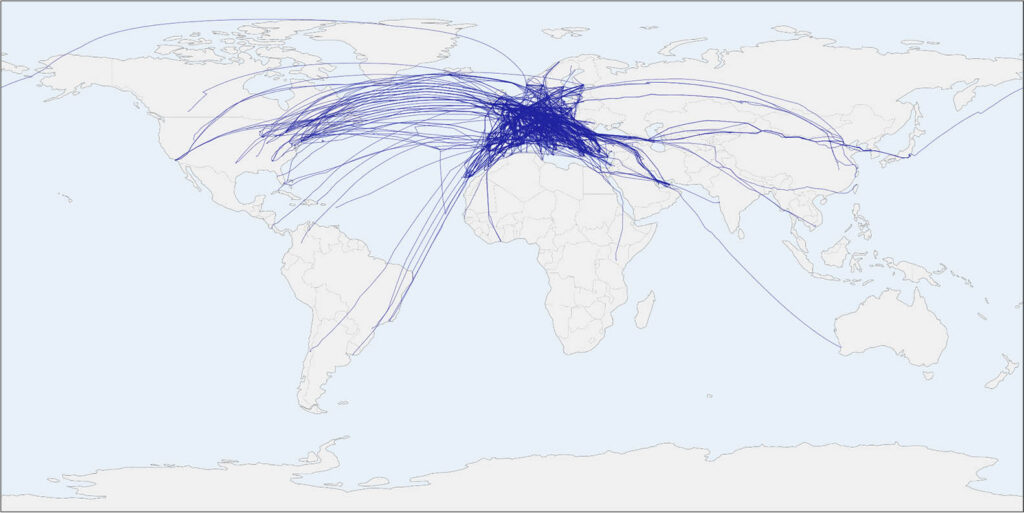
To turn this vision into a working auditing framework for evaluating non-CO2 measurement tools, Estuaire utilized approximately 8,000 Spire flight tracks. This real-world data-driven approach allowed Estuaire to bypass rigid synthetic assumptions and instead capture the true operational footprint of modern aviation.
Setting the global standard for aviation regulation
The strategic impact of NEAT FRAME-project extends far beyond a simple evaluation of non-CO2 tools. The benchmarks established by Estuaire and the European Commission will define the initial compliance requirements for alternative tools reporting within the EU MRV framework.
“Transparency is the foundation of progress. With modern tracking capabilities like Spire’s, aviation data is becoming more accessible, giving us the insight needed to better understand the sector’s impact on climate change and develop the tools that will help monitor, manage, and ultimately reduce that impact.”
Share on Facebook Share on Twitter Share on LinkedIn
Establishing these verified evaluation tools is the first step toward active climate mitigation within the aviation industry. Once the industry can reliably measure non-CO2 impacts, airlines can confidently implement targeted navigational contrail avoidance.
By doing this they potentially reduce the aviation climate impact by a large fraction for a small abatement cost ($1 to $7 USD per ton of CO2 avoided). An option that is two orders of magnitude lower than almost any other abatement option available to aviation today.
Fighting climate change through data
As climate regulations evolve, accurate data has become the ultimate industry currency. Estuaire’s day-to-day services are already supporting an entire ecosystem of aviation stakeholders facing pressure to prove their sustainability metrics: airlines optimizing flights to reduce contrails, airports tracking ground emissions, financial institutions tracking sustainability performance of airlines and airports; and manufacturers assessing fleet performance and monitor climate impact on such fleets.
Through high-value projects like the NEAT FRAME-Project, the collaboration between Estuaire and Spire proves that global satellite and flight data is no longer just a tool for flight efficiency – it is becoming the very foundation of international environmental policy.