Spire AI-S2S: A more accurate, differentiated sub-seasonal weather forecast
A 200-member generative AI ensemble, built fully in-house, independent of public sub-seasonal models, and verified to outperform the ECMWF’s sub-seasonal-range forecasts (S2S)* across all forecast lead times, most notably weeks 3-6, when other models trend to climatology.
Bottom line for the trading desk
Sub-seasonal forecasting, weeks 3-6, is a notoriously low-skill regime. Spire AI-S2S, our 200-member probabilistic ensemble, turns this horizon from a “no-signal zone” into an edge with meaningful improvements in forecasting skill over climatology and public sub-seasonal models.
Independent weather regime signals and probabilistic risk lets you size, time, and de-risk positions before public consensus reprices the market.
Spire AI-S2S vs. ECMWF-S2S VS. Climatology | Jan 1 – Feb 15, 2026
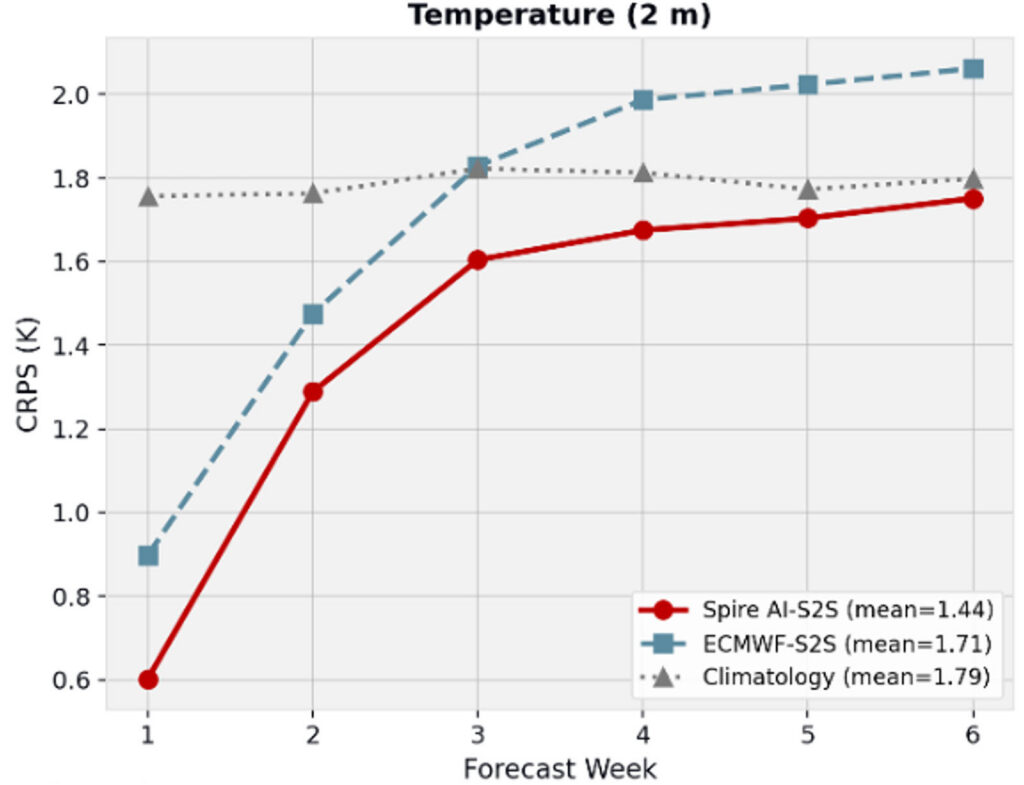
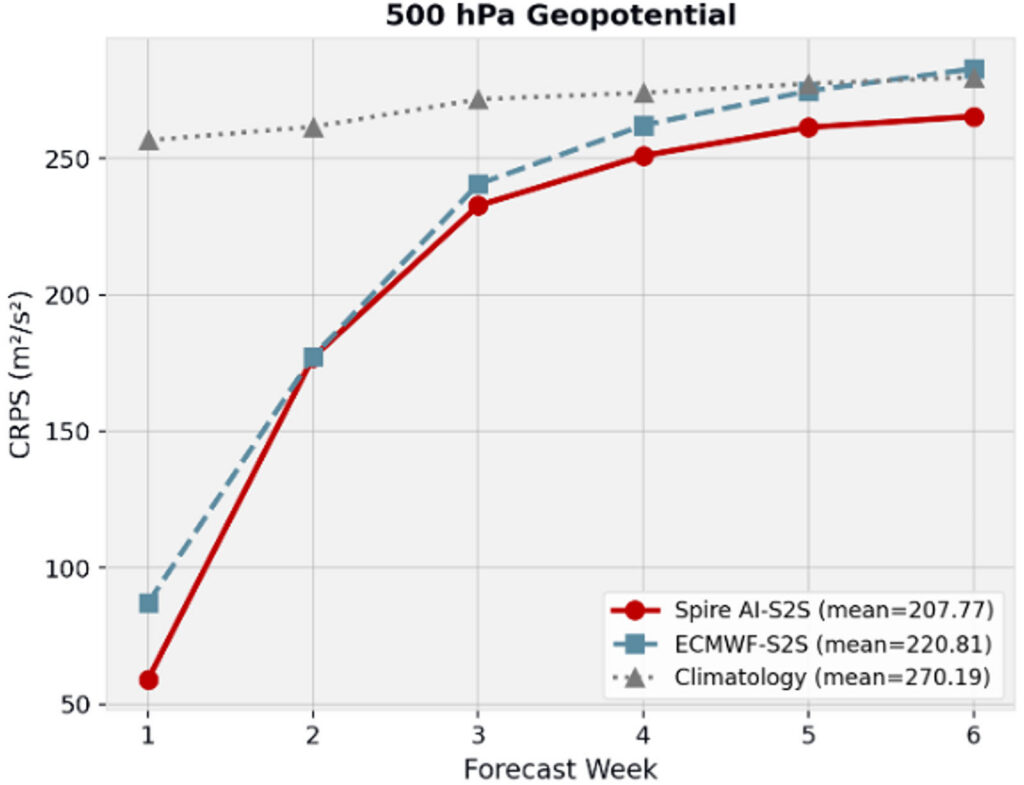
Spire validated its AI-S2S model against ECMWF’s S2S* over a 6-week verification period from January 1 – February 15, 2026. Each model was scored on its native grid against ECMWF’s ReAnalysis 5th Generation (ERA5), a global climate and weather dataset, using CRPS (Continuous Ranked Probability Score; lower = higher forecast skill).
AI-S2S validation by the numbers against ECMWF’S S2S*: Jan 1 – Feb 15, 2026, weeks 3–6
+14.76%
Improvement on 2-meter temperatures
+4.70%
Improvement on 500 mb heights
200
Spire AI-S2S ensemble members calibrated for tail risk events and clustering of scenarios
Why it matters to traders:
- Accuracy: 14.76% improvement over ECMWF’S S2S* on 2-m temperature and 4.70% improvement on 500 mb heights, verified against ERA5 using CRPS (Continuous Ranked Probability Score). Reforecasts available for independent verification.
- Independent signal: A generative AI-based sub-seasonal to seasonal (S2S) model developed entirely in-house, 100% independent of public sub-seasonal models, providing truly distinct forecasts out to six weeks.
- Weather regime shifts: AI-S2S better captures the large-scale circulation patterns in weeks 3-6 that drive the biggest P&L moves — winter cold snaps, wind droughts, summer heat waves — enabling earlier conviction on entry and exit timing.
- Skill relative to climatology: Outperforms climatology out to 6 weeks, when most S2S forecasts lose accuracy and trend toward climatology beyond week 3. In that 3-6-week window, even modest accuracy gains carry outsized value for forecasting and decision-making.
- Probabilistic distribution: 200 ensemble members produce clear clustering of likely weather scenarios, with enough members to see the peaks, quantify tail risk, and enable confident trading positions instead of binary bets.
- Insights: Raw model output is translated into trader-ready signals, including weather regimes, anomalies, and percentiles available now in our Cirrus Data Display Platform and via API, with Madden-Julian Oscillation (MJO) maps coming soon — so the post-processing work is already done for you.
*Spire conducted independent validation of data from its AI-S2S model, outside of the training and fine-tuning period, against ECMWF forecast data from January 1 – February 15, 2026. The ECMWF data used in this validation is published under a Creative Commons Attribution 4.0 International (CC BY 4.0) license. These results are based on data and products of the European Centre for Medium-Range Weather Forecasts (ECMWF) – ©2026 European Centre for Medium-Range Weather Forecasts (ECMWF). Source ecmwf.int.