Energy trading: see earlier, act faster
14.76% outperformance of ECMWF’s sub-seasonal-range forecasts (S2S)*
Seize opportunities, lower risk, and optimize P&L with forecasts powered by Spire’s space-based data. Probabilistic forecasts validated to beat ECMWF’s S2S by 14.76% for surface temperatures at 3-6 weeks.*
Early signals from intraday wind ramps to 45-day weather regime shifts enable your desk to act before competitors.




Weather moves markets
Weather volatility is now energy market risk
A wind ramp missed by an hour. A cold outbreak or heat wave flagged too late. A weather regime change the desk never saw coming. Each one is a P&L event.
Weather drives power generation, demand, and price. As renewables expand, market volatility increases. Accuracy and speed determine who profits.
Decision-ready intelligence
The Spire advantage for energy traders
Space-based, decision-ready weather intelligence built for how traders work.


See earlier, act faster
Detect market-moving weather and demand anomalies up to 6 weeks ahead, before public models pick them up.

Trade smarter
AI-S2S is trained on Spire’s proprietary satellite data and runs independently of every public S2S model. So, when the market gets it wrong, you don’t.

Capture ramps others miss
3 km High-Resolution Forecasts and Optimized Point Forecasts deliver clean intraday signals on wind, solar, and load.

Price risk weeks out
Spire AI-S2S model forecasts to 45 days, validated to outperform ECMWF’s S2S by + 14.76% on temperature.* Price gas demand and hedging exposure.

Trade-ready decision dashboard
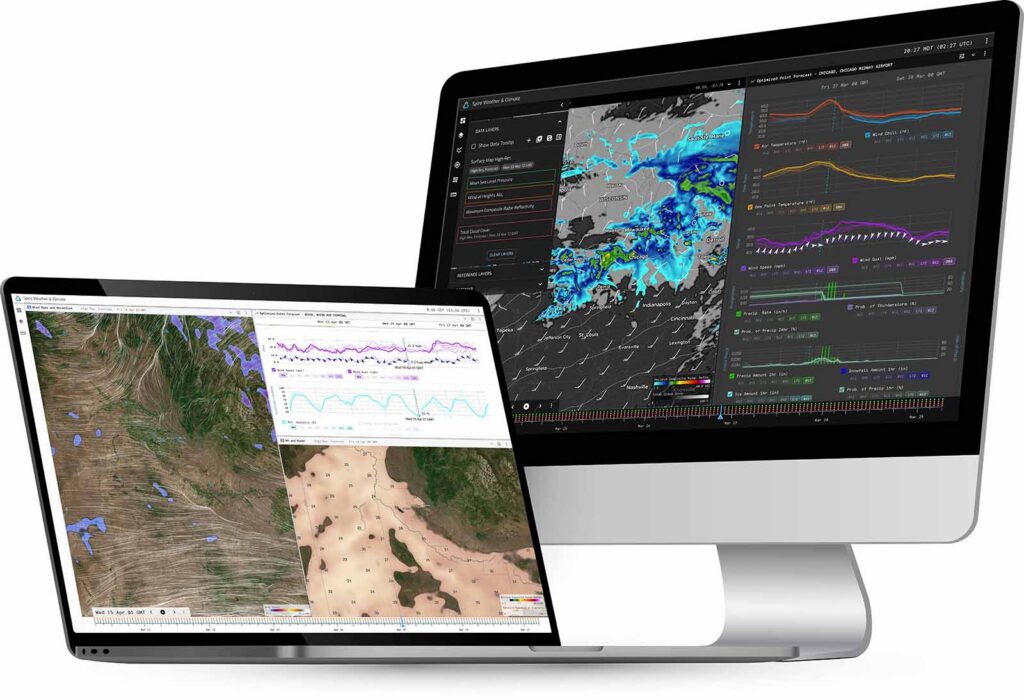
Cirrus brings every Spire forecast plus public models into a single trader-grade dashboard. Compare runs, anticipate regime shifts, inspect power forecasts in one platform.

Plug into your workflows
API delivery integrates directly into your trading models, tools, and dashboards. No rebuild required.
Where traders lose edge, and where Spire gives it back

Trading without Spire
Public forecasts blur the signals that move power and gas markets. Wind ramps slip past. Load swings get mispriced. You react to the market instead of pricing ahead.

Trading with Spire
Spire feeds sharper signals into your stack ahead of the market. You read demand and generation ahead of competitors, with ramp capture and scenario depth in one platform.
Energy trading forecasts
Intraday to sub-seasonal: the forecast stack built for energy trading
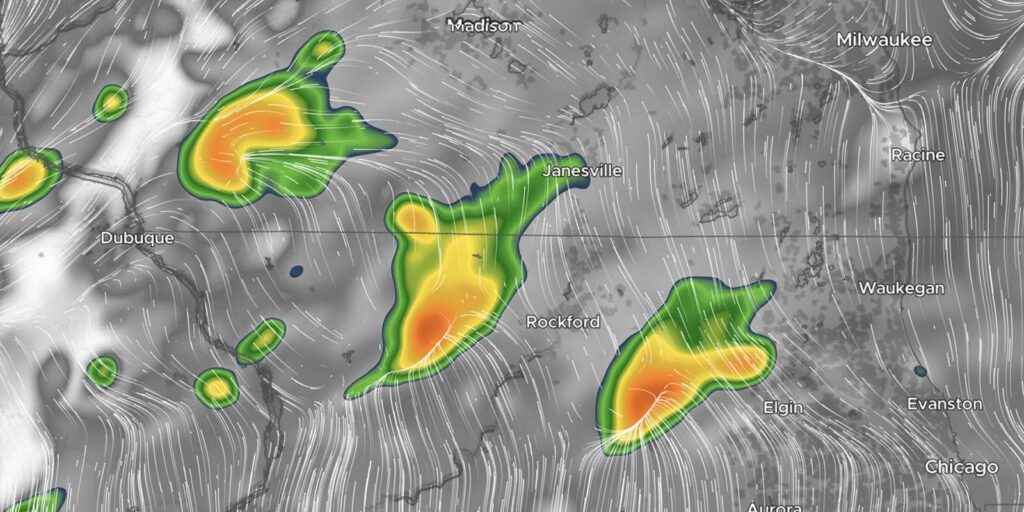
0-7 days
High-Resolution Forecast
Twice-daily 3 km forecasts across the US, Europe, and Southeast Asia. Resolves wind ramps up to 7 days out. Custom domains on request.
- Catch the ramp
- Day-ahead positioning
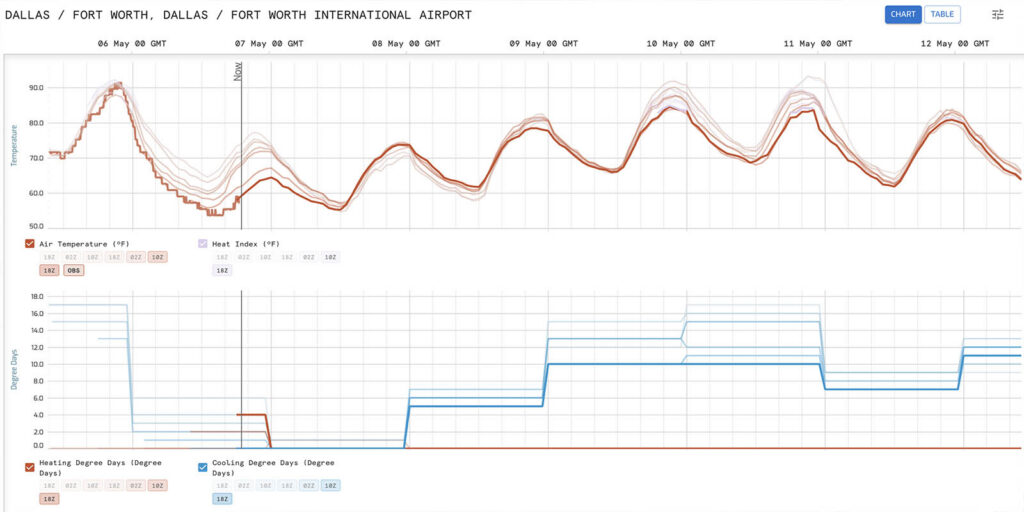 0-15 days
Optimized Point Forecast
Asset-level forecasts at the specific node calibrated to local site conditions. Hourly-refreshed, with 15-minute granularity out to 15 days.
- 10,500 sites today
- Custom locations anywhere in the world
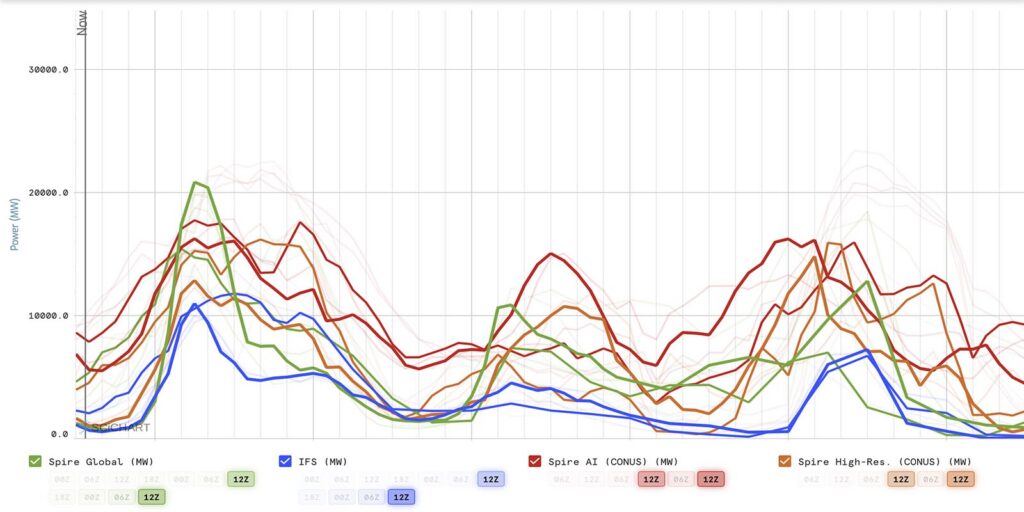 0-15 days
Power Generation Forecast
Wind & solar generation across all US ISO/RTOs and 6 European markets — in megawatts, not just weather.
- All US markets
- 6 EU markets
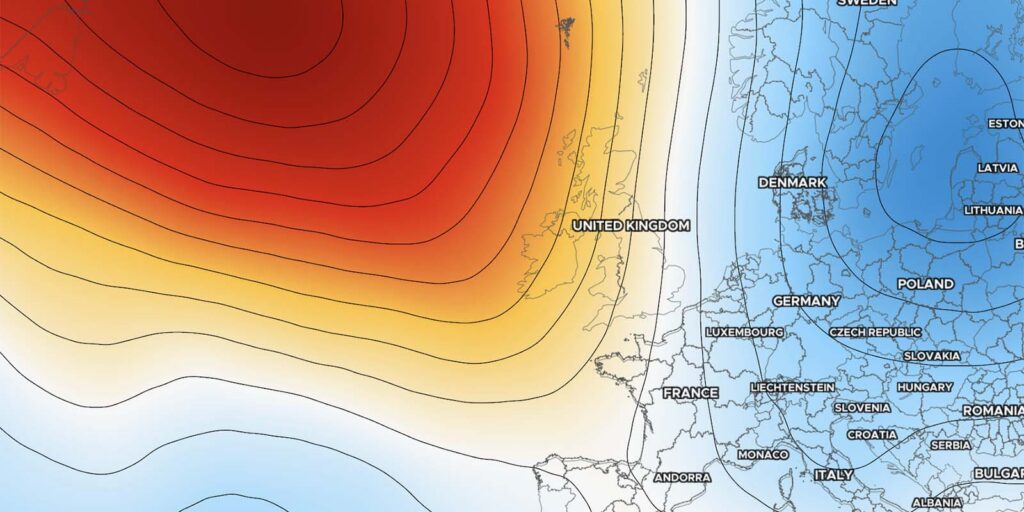
1-45 days
AI-S2S
Daily forecasts with quantified uncertainty, anomalies, and percentiles. Weather regime layer tuned for NA & European trading. Validated to beat ECMWF’s S2S at 3-6 weeks for surface temperatures and 500 mb heights.*
- 200-member calibrated ensemble
- Quantifies tail risks (cold extremes, heat waves)
Cirrus data display platform
The full stack. One Platform. Decision-ready and built for how traders work.
Cirrus puts every Spire forecast alongside the public models you benchmark against on a single trader-grade screen. Compare runs, surface anomalies, and pressure-test your view before the market sees it.
- Side-by-side model comparisons across Spire and public forecasts
- Trends, anomalies, and percentiles at a glance
- Power Generation Forecasts in your market and time zone
Or bring the data into your workflows and models via our weather forecast APIs without the need for a new platform.
Head-to-head with ECMWF’s S2S: AI-S2S wins at extended range*
Spire AI-S2S vs. ECMWF-S2S vs. Climatology | Jan 1 – Feb 15, 2026
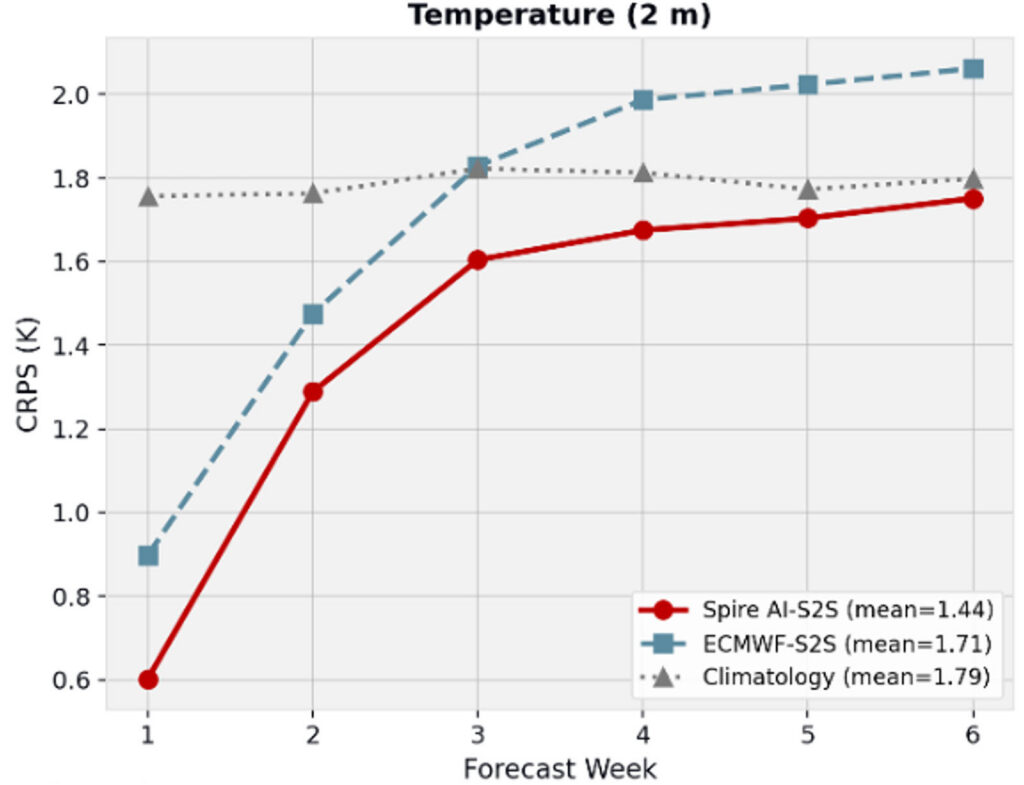
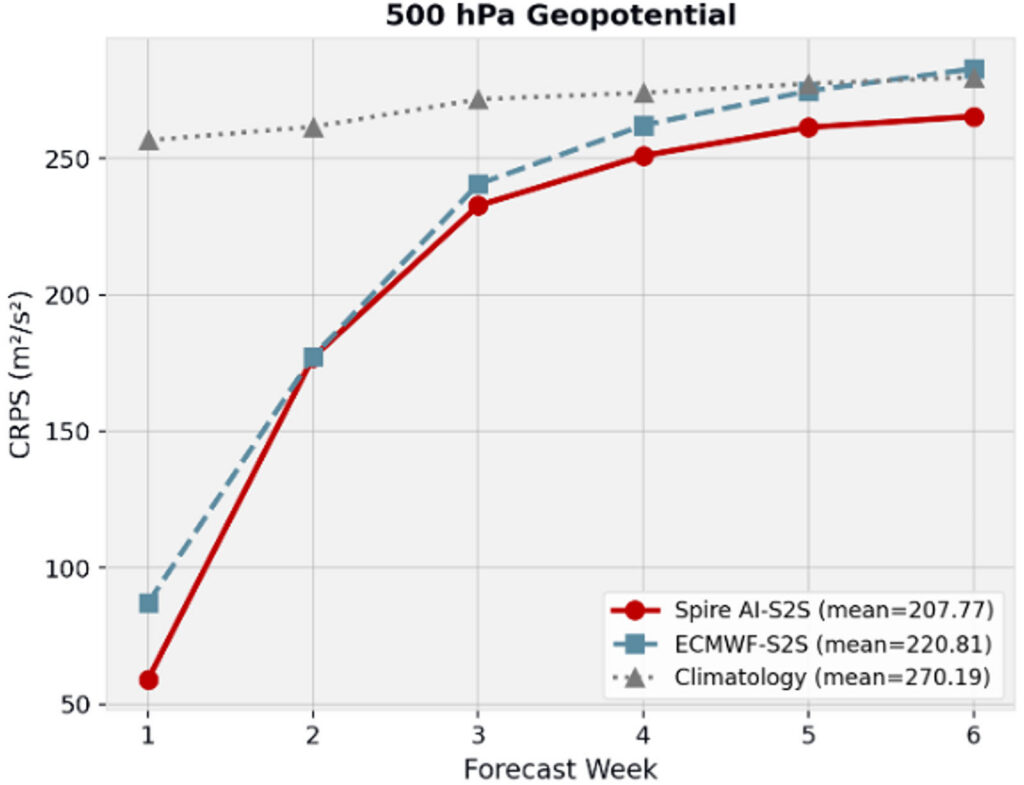
Each model scored on its native grid against ERA5 reanalysis. Full validation methodology available on request.
*Spire conducted independent validation of data from its AI-S2S model, outside of the training and fine-tuning period, against ECMWF forecast data from January 1-February 15, 2026. The ECMWF data used in this validation is published under a Creative Commons Attribution 4.0 International (CC BY 4.0) license. These results are based on data and products of the European Centre for Medium-Range Weather Forecasts (ECMWF) – ©2026 European Centre for Medium-Range Weather Forecasts (ECMWF). Source ecmwf.int.
Featured resources
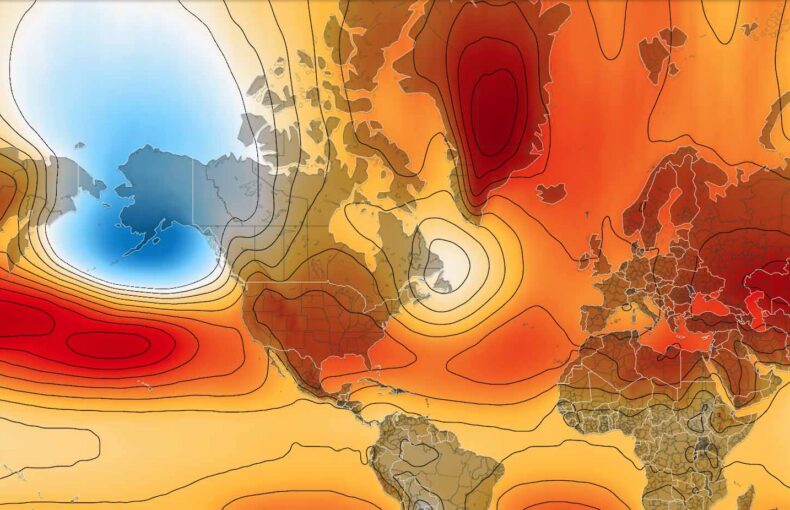
Spire AI-S2S: A more accurate, differentiated sub-seasonal weather forecast
A 200-member generative AI ensemble, built fully in-house, independent of public sub-seasonal models, and verified to outperform the ECMWF’s sub-seasonal-range forecasts (S2S)* across all forecast lead times, most notably weeks 3-6, when other models trend to climatology.
How weather-driven volatility in energy markets creates profit opportunities
As renewable energy production surges and electricity production becomes increasingly weather-dependent, forward-thinking businesses are seizing new opportunities to act like energy traders – with the help of AI weather forecasting tools.
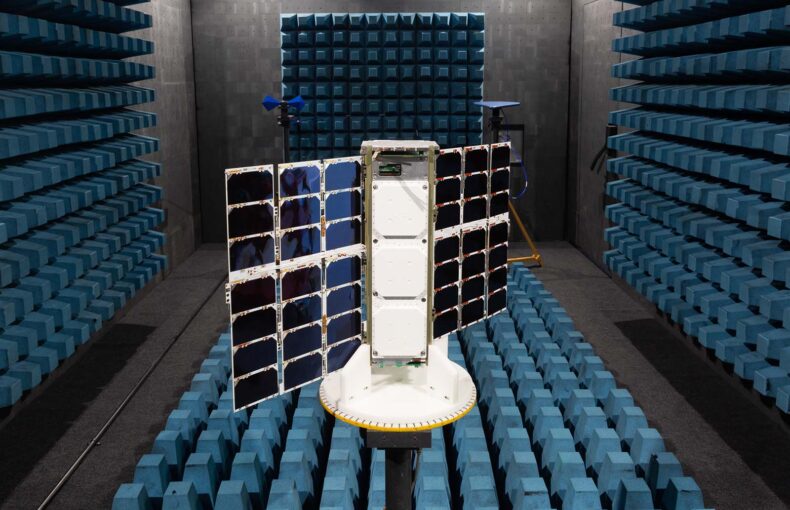
Decoding Radio Occultation, the cornerstone of accurate weather forecasting
Weather forecasting has come a long way, yet challenges persist in predicting extreme events and understanding long-term climate patterns.
Weather solutions
Our tailored weather solutions
All the solutions you need for better-informed decisions

DeepInsights™
Experience a comprehensive suite of weather forecasting tools and data visualization capabilities.

DeepVision™
Monitor your entire network of assets, both fixed and moving, in a single viewing application.